Not Everything Should Be Automated — Deciding What Deserves It
Why most AI projects fail at the first governance gate: they automate the wrong work. Atlas doesn’t just execute—it filters.
Key takeaways
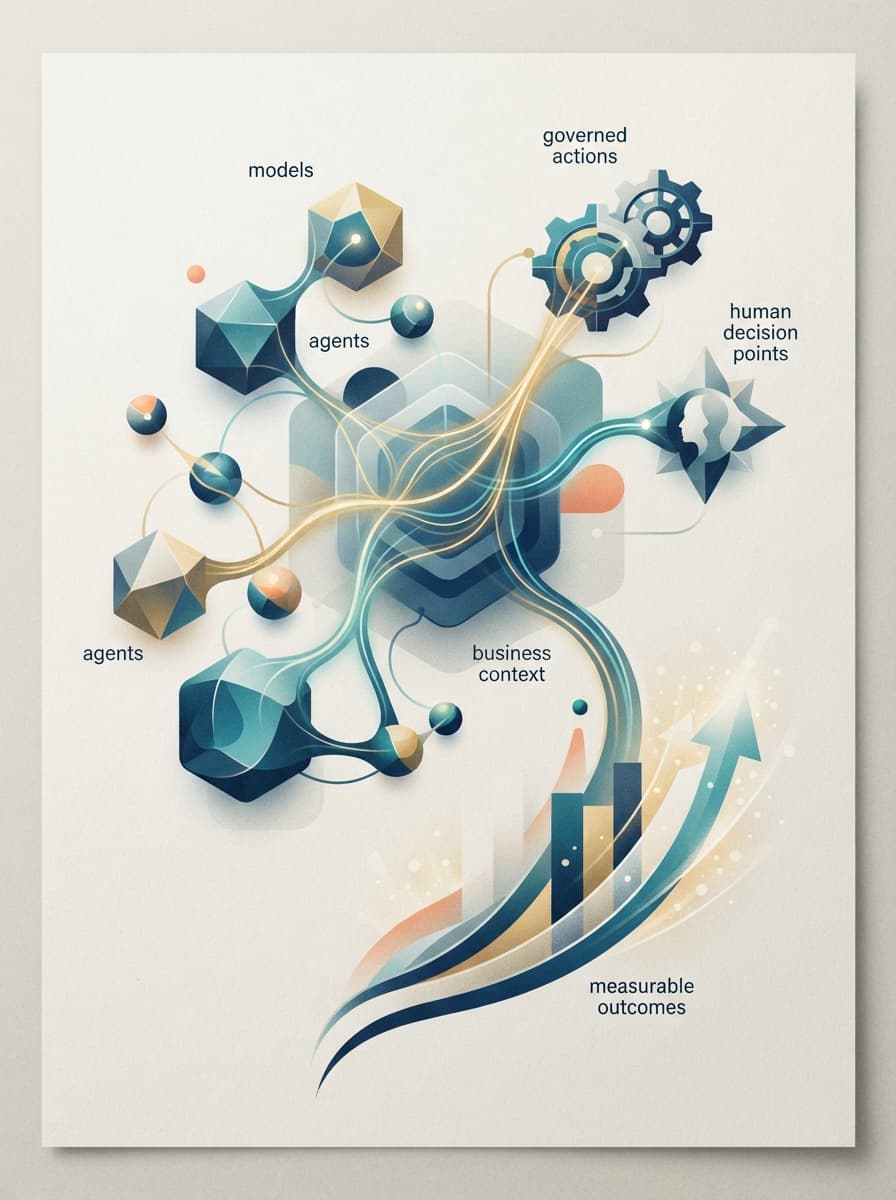
- Most AI projects automate work without first defining what *should* be automated—Atlas filters before it executes.
- A Business AI Harness doesn’t just connect models to tools; it governs which workflows are worth running, measuring value before cost.
- Governance isn’t about restriction—it’s about ensuring AI acts on work that moves the business forward, not just work that *can* be automated.
- AI Value Indicators (AVIs) tie automation to outcomes, not just token usage or task completion.
The first rule of AI automation: don’t automate what shouldn’t exist
You’ve seen it before. A team connects a model to a workflow, flips the switch, and declares victory. Three months later, the system is running tasks no one actually needed—just because it *could*. The problem isn’t the model. It’s the lack of a harness to decide what work deserves to run in the first place.
Atlas doesn’t start with execution. It starts with governance. Before an agent touches a tool, the harness checks: Is this work aligned with business goals? Does it have measurable value? Is it reversible if something goes wrong? If the answer isn’t yes, the work doesn’t run. Full stop.
✦ Governance as a filter, not a gate
Governance in an AI Harness isn’t about blocking work—it’s about ensuring the right work gets done. Think of it like a bouncer at an exclusive club: not everyone gets in, but those who do are there for a reason.
This isn’t theoretical. We’ve lived through the SaaS graveyard of tools that automated busywork because it was easy. The result? Teams drowning in low-value outputs, chasing metrics that don’t move the needle. A Business AI Harness flips the script: it measures value before it measures cost.
AI Value Indicators: The difference between automation and effectiveness
Token usage is a cost metric. Task completion is an activity metric. Neither tells you if the work mattered. That’s where AI Value Indicators (AVIs) come in.
AVIs tie AI activity to business outcomes. Did the agent’s work reduce cycle time? Improve quality? Increase recommendation acceptance? If the answer is no, the harness flags it—not to stop the work, but to ask why it’s running at all. This isn’t about policing AI. It’s about ensuring AI acts on work that *deserves* to be automated.
- Work completed → *Did it move the business forward?*
- Time saved → *Was that time reinvested in higher-value work?*
- Errors avoided → *Did it prevent a real problem, or just a hypothetical one?*
✦ AVIs in practice
Atlas tracks AVIs like revenue influenced, cost per successful outcome, and quality improvement. These aren’t vanity metrics—they’re the guardrails that keep AI from becoming another SaaS graveyard.
The harness doesn’t just execute—it learns what *should* be executed
Most AI systems learn from prompts and outputs. Atlas learns from *decisions*. When a human approves, rejects, or corrects an agent’s work, the harness logs it. Over time, it builds a model of what work is worth automating—and what isn’t. This isn’t just feedback. It’s evolution.
The result? A system that gets smarter about *what* to automate, not just *how* to automate it. That’s the difference between an AI add-on and a Business AI Harness.
Let’s be honest: if your AI strategy starts with ‘What can we automate?’ you’re already behind. The right question is ‘What *should* we automate?’ Atlas doesn’t just answer that question—it enforces it.
See it on your own data.
Connect your tools and Atlas shows you what matters.
Frequently asked questions
How does Atlas decide what work is worth automating?
Atlas uses governance rules, AI Value Indicators, and human feedback to filter work. If a task doesn’t align with business goals, has no measurable value, or lacks reversibility, the harness won’t run it—no matter how easy it is to automate.
What happens if an automated task doesn’t deliver value?
The harness flags it for review. If the task consistently fails to meet AVIs, Atlas either adjusts the workflow or stops running it. The goal isn’t to automate everything—it’s to automate the right things.
Can Atlas override human decisions about what to automate?
No. Atlas enforces governance rules and flags misaligned work, but humans retain final approval. The harness is designed to *support* judgment, not replace it.
Keep reading
Related resources
Why Your AI Agents Keep Hitting the Same Wall—And How to Fix It
BlogWhen Your AI Strategy Is Just a Model with Nowhere to Go
BlogPast the Spreadsheet: Making AI Accountable, Not Just Another File
BlogMeasuring Work Differently in the Age of AI
BlogAtlas Now Speaks Files, Images, and Voice—Without Losing the Plot
BlogQuestioning the Work Itself: What Should Even Exist to Automate
Newsletter
The consolidation memo.
Practical insights on AI, operations, and the future of business software. No fluff.